

By Sekhar Paladugu, Senior Manager of Strategic Initiatives, Next50, and Kathy Plomer, Community Impact Manager, Next50
There is a saying you hear in the San Luis Valley, and it reframes everything that comes after it: we didn’t cross the border — the border crossed us.
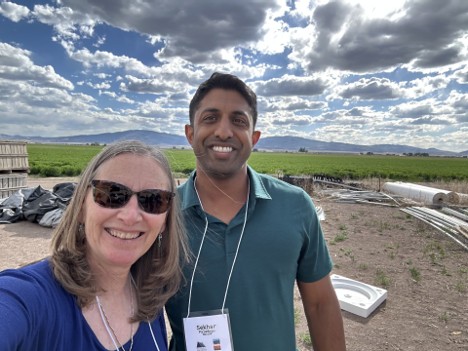
In June, Next50 joined a cohort of Colorado funders for a two-day immersion in the San Luis Valley, hosted by Philanthropy Colorado’s Rural Funders Learning Network and the Community Foundation of the San Luis Valley. The Valley is one of the largest alpine valleys in the world; it’s a high-desert basin of over 8,000 square miles ringed by the Sangre de Cristo and San Juan ranges.
This region is home to a sizable Hispanic community with deep Spanish, Mexican, and Native American roots that predate Colorado statehood. As funders, we came to listen: to meet the people who live and lead here, to understand the needs on the ground, and to explore opportunities to support the community.
What We Did
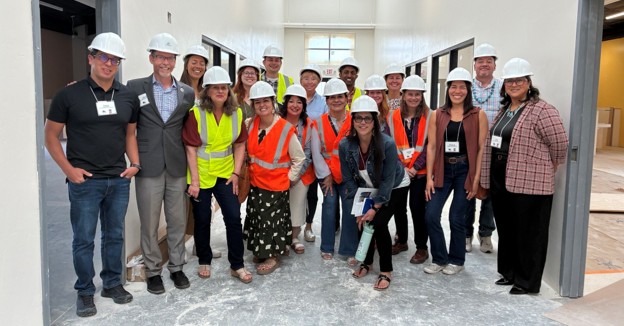
Over two days, organized by local leaders, we:
- Learned about the Valley’s pioneering role in school desegregation through the 1914 Maestas case and the mutual aid work of SPMDTU at their historic hall in Antonito.
- Toured the Sand Dunes Mushroom Co-op outside Monte Vista, a worker owned operation building their farm’s capacity.
- Learned about intergenerational mentoring for at-risk youth at the Shooting Stars Cultural and Leadership Center and heard from the SLV Housing Coalition as well as the SLV BOSS worker-ownership financial services cooperative.
- And, in the spaces between, we talked at length with local older adults and caregivers.
What We Heard
While the major emphasis of the panels and presentations were on capital needs and on next generation leaders and community members in the Valley, we at Next50 know aging will also be a central factor in San Luis Valley.
If one theme threaded through informal conversations and stories relating to meeting the needs of older adults in The Valley, it was caregiving in a rural care desert. Families navigating dementia, caregiving at home, guardianship, benefits, and finances largely alone. Few Medicaid long-term care options or adult day programs within reach. A thin direct-care workforce, in-home care that barely exists, and little support for the unpaid family and friends doing the work.
These stories are added texture behind the data in Next50’s own Aging at Altitude report. These are among the poorest counties in Colorado, where roughly one in three older adults faces economic insecurity, where 13 of the state’s 64 counties have no hospital and 11 have no pharmacy, and where Medicaid-accepting facilities carry months-long waitlists. The need is real, concentrated, and urgent.
Philanthropy’s Role
The financial needs across Colorado’s 64 counties are too great for philanthropy alone to solve. Funders need to be honest about that with the communities we serve and work together on ways to support rural areas.
To be clear, we know that direct funding has a strong role to play in rural philanthropic ecosystems. Our rural grantees often make note of how far they stretched their grants dollars and how much Next50’s support multiplied through unlocking other funding for their work. We will continue to support grantees focused on aging in every county in Colorado and will continue to look for new opportunities to partner and support locally led work in the years to come, including in the Valley. In San Luis Valley specifically we have supported organizations like Adams State University, Crestone Living Wisdom Village, and others.
Alongside our responsive support though, we must look at new approaches. The math bears out this story. Over our first decade, Next50 has invested nearly $90 million across all 64 Colorado counties and 41 states, supporting more than 625 nonprofits. That’s meaningful, and we’re proud of it. But a single foundation’s annual payout cannot sustain an entire aging safety net, especially as public funding at all levels for aging-focused programs have experienced massive cuts. If we only wrote checks, we’d be emptying out the ocean with a teaspoon.
So the question isn’t just how to write bigger checks? It’s, how do we change the conditions?
What We Believe
At Next50, we believe in both community responsiveness and systems change, and we pursue it through what we call a polycapital approach — deploying the full spectrum of tools, not just grants: program-related investments, mission-aligned endowment investing, policy & advocacy efforts, and community engagement, all working toward one goal of building a world that values aging.
You can see the logic in the kind of work that would matter in a place like the Valley. Rather than only funding home care visits, we’ve put $750,000 behind the Rocky Mountain Employee Ownership Center to launch Colorado’s first employee-owned home care cooperative — a scalable, community-based model that raises caregiver wages, reduces turnover, and improves care. Similarly, the Colorado Nonprofit Bridge Loan. Fund keeps essential services at nonprofits across Colorado running when delayed government payments would otherwise force closures. As these models expand, they can especially target rural and underserved areas with community-driven approaches, at times with capital that is recycled back into the communities.
But one of the most impactful tools is policy. At the end of 2025, Next50 seeded a new, independent, nonpartisan advocacy organization — Leverage Colorado — with a $3 million investment to make aging more affordable for every older adult in the state, and for the caregivers beside them. Policy investments like the one we made in Leverage have the potential to change the conditions in all 64 counties, particularly rural areas like the San Luis Valley.
Bringing It Home
The caregivers we met in the San Luis Valley — drowning in navigation, isolated in their hard-won expertise, doing this work on top of their day jobs — are exactly who systems change must serve. They need more than a one-time gift. They need a state where state-funded in-home care exists, where the direct-care workforce is paid a living wage, where public benefits aren’t a maze, and where their own labor is recognized and supported. Organizations serving a myriad of needs deserve a balanced approach of community-responsive support and systems change solutions that create conditions for success and change.
That’s the leverage the Valley taught us to look for. Frontline learning is pointed at systems-level change. We’ll carry what we heard here into how we deploy every tool we have.
Our thanks to Philanthropy Colorado’s Rural Funders Learning Network, the Community Foundation of the San Luis Valley, and every leader who gave us their time and their stories.


 English
  Español de México